
Image: Mohamed Hassan from Pixabay
- SEO (Search Engine Optimization)
- AEO (Answer Engine Optimization)
- GEO (Generative Engine Optimization)
First, there was just one acronym: SEO. Today, it’s like you’re walking past a daily-expanding buffet showcase of acronyms for optimization as a fundamental part of online marketing. And when you haven’t even fully digested SEO, every other article is already putting AEO and GEO onto your plate, all while reassuring you, “Trust me, it’s worth a taste!”
Some are already claiming: “AEO is the new SEO!” At the same time, others strongly advise relying on GEO as a more comprehensive approach in the search kitchen, where artificial intelligence is slowly but steadily growing into a master chef.
So, what’s the difference between SEO, AEO, and GEO? Should you pick and prioritize only one or perhaps absorb them all in equal (or not so equal) parts?
Let’s have a closer look at each.
What you need to know about SEO, AEO, and GEO
SEO, AEO, and GEO aren’t competing tactics. They’re interconnected layers of modern search visibility.
While SEO builds discoverability in traditional search engines, AEO and GEO reflect how people increasingly find information through AI-driven answers and generative platforms.
Understanding how these approaches work together helps businesses stay visible across every stage of search behavior.
Learn from Tyler Denk, Co-founder and CEO at beehiiv, who I spoke to recently. He’s used SEO extensively to promote their newsletter platform in various search engines. But quite recently, he’s started exploring AEO and GEO for online visibility and conversions.
Weighing these three options as part of their digital marketing implementation, Denk told me:
“SEO still drives consistent demand, but AEO and GEO are becoming essential as audiences shift toward AI-powered discovery. If you want your brand to show up where decisions are actually being made, you can’t rely on just one optimization model anymore.”
With that perspective in mind, let’s start by breaking down the foundation of all three.
What is Search Engine Optimization?
As a digital marketer, you've probably long understood the SEO fundamentals. As conventional as it goes, SEO makes a website or page found and ranked on traditional search engines, such as Google or Bing.
So, businesses do the following for an effective SEO strategy to land a higher ranking in the SERPs (search engine results pages):
- Off-page SEO → Backlinks, content syndication, PR promotion in marketing, etc.
- On-page SEO → Keywords, headings, titles, tags, or other elements on web pages.
- Local SEO → Google Business Profile listings, online reviews, keywords with location modifiers like states, cities/towns, neighborhoods, streets, etc.
- Tech SEO → Mobile-first pages, page loading speeds, well-structured URLs, site architecture etc.
When should you prioritize SEO in your optimization strategy?
- When you want to rank #1, not #201, in the SERPs.
- When your aim is to drive organic traffic to your website.
- When the search intent is commercial or transactional.
- When you’re targeting customers locally.
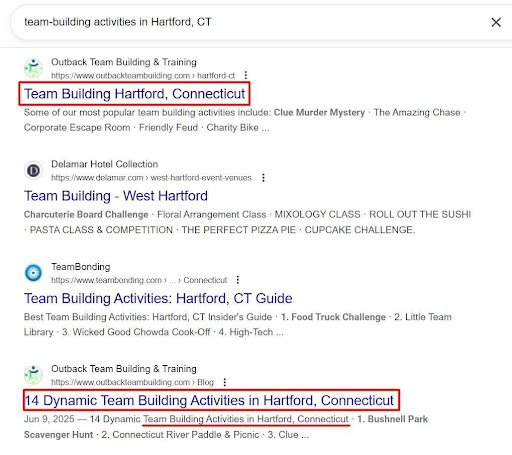
Let’s take the events industry and the search with the geographic modifier: “team-building activities in Hartford, CT”.
Notice how Outback ranks twice in the top ten of the SERPs, which means that, in addition to their content and relevance, they've successfully optimized for the local search.
What is Answer Engine Optimization?
To get straight to the point, AEO is focused on giving people exactly the information they ask for in its shortest and quickest form.
It involves optimization for:
- Question-and-answer (Q&A) formats
- Featured or rich snippets
- Frequently asked questions (FAQs)
- Google’s “People Also Ask” (PAA) section
- Voice searches
As people often seek direct answers from AI voice assistants (Alexa or Siri) or chatbots (Gemini or Copilot), who are geared to providing these answers, these technologies are reshaping the future of AI marketing and AEO.
When should you prioritize AEO in your optimization strategy?
- When you need to give a brief, concise answer to your audience.
- When you're competing for featured snippets.
- When you're targeting customers shifting to conversational AI and AI-powered voice search (location-based or not).
Suppose you need a quick answer in the area of property financing and ask: “What is a mortgage in real estate?”
At the top of the results, you get the following two-sentence response AEO-optimized for Google’s featured snippet, and a similar answer in the PAA section.

What is Generative Engine Optimization?
Unlike traditional SEO, GEO aims at making large language models (LLMs powered by AI) better understand and recommend your brand or content in AI-generated texts. A few of the main AI tools for searches include:
- ChatGPT
- Google’s AI Overview
- Claude
- Gemini
- Perplexity
While Google is still winning the search game with an estimated 14bn searches daily in 2024, ChatGPT received an estimated 37.5 million searches per day in the same period, opening up a vast field for GEO.
Although enterprises and SMBs are now starting to allocate and separate out some of their marketing budget to generative engine optimization, the percentages are still tiny, on average less than 1%.
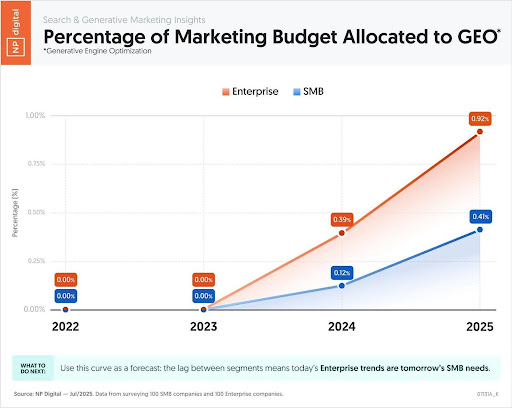
Source: Neil Patel on LinkedIn
When should you prioritize GEO in your optimization strategy?
- When you already have solid SEO bedrock. (Remember: GEO isn’t a replacement strategy for SEO, it’s rather a layer on top of it.)
- When you want to boost brand awareness with mentions, not necessarily with clicks-through (AI often generates answers without links).
- When you publish “evergreen” content (universal tips, how-to guides, listicles).
- When your audiences use generative AI for content discovery (including local search).
Look at this answer generated by ChatGPT when asked about Italian restaurants in NYC.
It provides links to GEO-optimized lists like “The 27 Best Italian Restaurants in New York City” by The Infatuation.
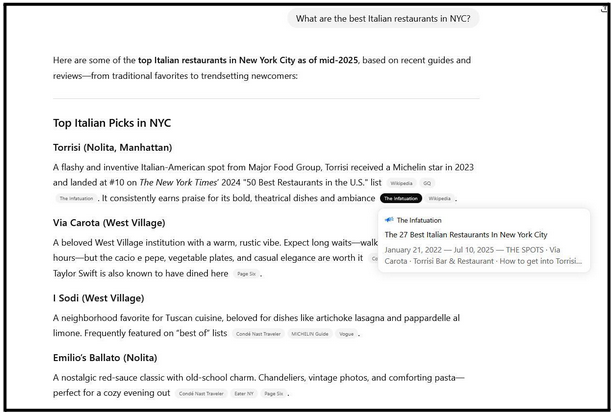
Image generated by the author via ChatGPT
SEO vs AEO vs GEO: What’s right for you?
Just as you create a balanced plate with different foods for a healthy diet, it makes sense to incorporate all three ingredients into your strategy.
The key takeaway is to decide on the right proportions based on your business goals and your audience’s needs.
The new tech-driven optimization opportunities are here to stay, but that doesn't mean the old ones are going away.
Over the years many developments in search have been heralded as the marking death of SEO, and yet… SEO is still with us and may be for some time to come.
For further reading on this, see our blog article Why AI might just save SEO.